Werther’s Ossian manuscript
The Sorrows of Young WertherWerther’s Ossian manuscript is a translation of songs by Ossian that becomes the central object in Werther and Charlotte’s final encounter. Kept in Charlotte’s drawer, it gives Werther a text to recite when neither can settle into ordinary conversation. Its scenes of bereavement and impending loss become more than literary performance: as the lovers recognize their own situation in the songs, the manuscript helps transform restrained unease into an emotional crisis that ends their meeting and anticipates Werther’s death.
Identity and Place in the Story
The manuscript is Werther’s own translation of some of Ossian’s songs. Charlotte has it in her drawer, but has not yet read it. She explains that she had hoped to hear Werther recite the songs, a wish she had been unable to fulfill for some time. The object therefore bears a history of postponed intimacy before it is opened: Charlotte knows the translation as Werther’s work and has imagined hearing it from him, while its words remain unread.
During their meeting, Charlotte asks whether Werther has brought anything to read. When he says he has not, she directs him to the drawer. He retrieves the manuscript with a shudder, then sits down and begins reading with tears in his eyes. His reaction precedes the full force of the passage itself. The manuscript is already charged for him, and Charlotte’s invitation turns that private charge into a shared experience.
Songs of Loss and Transience
The recitation opens with an evening star above a plain where the storm has subsided and distant waters still roar. The star smiles and departs; the poem then calls for the light of Ossian’s soul to rise. That movement from a departing natural light to a summoned voice establishes a pattern that recurs throughout the songs: presence is temporary, while memory keeps the absent close enough to mourn.
The remembered gathering brings Fingal and the bards Ullin, Ryno, and Alpin into view, alongside Minona’s lament. Their former fellowship is contrasted with how they have changed since the feast at Selma. The songs then turn to Colma, left alone on a hill after Salgar fails to return, and later to Arindal, Daura, and Armar, whose deaths leave a father grieving at the shore. The lament culminates in the image of children’s ghosts walking together by the setting moon. Across these episodes, the manuscript gathers scenes of separation, violent loss, waiting, and bereavement; the returning figures are present only as memories or spirits.
The later lines about spring sharpen the same pattern into a direct warning about beauty’s short life. The speaker hears spring’s promise of heavenly dew but foresees decay and a coming storm; a traveler who once saw the speaker in beauty will return and find nothing. Werther’s response makes the passage’s relevance immediate. The poem’s contrast between remembered beauty and anticipated absence falls on him with despair, rather than remaining safely contained within an old lament.
Recitation and Emotional Convergence
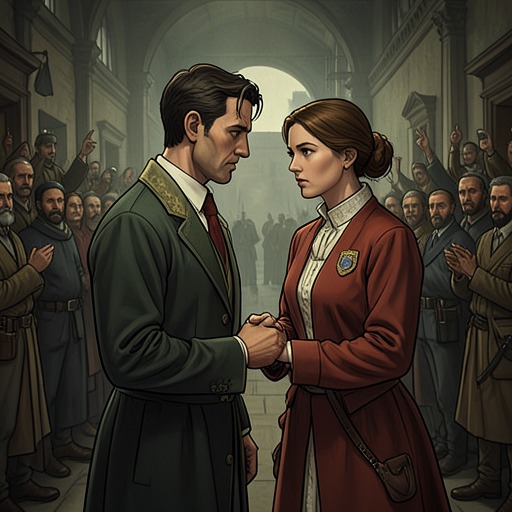
The reading is interrupted when Charlotte’s tears stream down and relieve her distress. Werther throws down the book, takes her hand, and weeps; Charlotte hides her face in her handkerchief. The narration makes their recognition explicit: both feel that their fate is pictured in the misfortunes of Ossian’s heroes. The manuscript thus acts as a mirror, but not because the lovers’ circumstances duplicate any single episode. Its accumulated stories of failed return and irreversible loss give form to the danger already pressing on their meeting.
Charlotte tries to recover her composure and asks Werther earnestly to leave. He trembles, takes up the manuscript again, and resumes reading in a voice broken by sobs. The return to the text is a consequential choice within the scene: the songs do not calm the pair or restore distance between them. Instead, the lines about spring’s approaching decay intensify Werther’s despair. He falls at Charlotte’s feet and presses her hands to his eyes and forehead. For the first time, she apprehends his fatal intention. Her pity draws her toward him, and the two lose sight of the world around them before he embraces and kisses her.
Consequences and Narrative Significance
The manuscript’s role in the encounter is inseparable from the boundary Charlotte ultimately reasserts. She pushes Werther away and tells him that this is the last time he will see her. After she rushes into the adjoining room and locks the door, Werther remains on the floor, then pleads for one last word at the closed door. Receiving no answer, he leaves, calling his farewell to her. The text has brought their feelings into painful proximity, but it cannot change the separation that governs their lives.
As an object, the manuscript joins translation, memory, and impending loss in a single scene. Werther’s recitation carries Ossian’s distant mourners into the room; Charlotte’s tears and Werther’s renewed reading make the old laments feel like an image of their present. The spring passage’s promise of disappearance also foreshadows the story’s ending without resolving the lovers’ conflict. The manuscript gives their grief a language and a pattern, while its effect exposes the danger of treating poetic recognition as a way out of reality: the shared emotion deepens their intimacy, but the encounter ends in rejection and Werther’s departure.